Defenders of Hogwarts: Rules & How to Play
How Defenders of Hogwarts plays: 2–5 players, setup, the Dark Arts Path, the Loyalty track and how each side wins — explained in plain English with verified parameters.
Visual Rules & Strategy Guides
Every rule, mechanic, and table scenario explained in intuitive one-glance architectural cards.
The Defence Shield Recipe
1 Library Book + 1 Ancient Scroll + 1 Dark Detector or D.A. Coin. Forge two shields to immediately seal Hogwarts.
Inspect Recipe Formula →A House Player's Turn
Pick Explore (move 3 pawns), Learn (acquire spells & books), or Replenish (cycle hand), plus free trading actions.
Read Turn Breakdown →The Dark Arts Path
Three zones (White, Orange, Red), three progress tokens, and the terrifying 3-2-1 follower convergence finale.
Dark Arts Mechanics →Loyalty Track & Room of Requirement
How Dark Detectors, Sneakoscopes and enchanted D.A. Coins enter play as student loyalty advances.
Loyalty Guide →Card Anatomy & Keywords
Decoding movement icons, reactive spell triggers, zone requirements, and MinaLima foil artwork layout.
Card Anatomy Guide →Table Layout & Checklist
2 to 5 player pawn counts, board orientation, starter deck assembly, and opening item placement.
Step-by-Step Setup →The 7×7 Hogwarts Grid Map
Navigating Great Hall, Dungeons, Astronomy Tower, 4 shield spaces, and all 33 Dark Arts path tiles.
Explore Castle Map →11 Library Books & Spells
The complete Acquire Row breakdown: ancient tomes, starter house decks, and high-synergy spell combos.
Library Catalog →The Short Version
2–5 players · Ages 13+ · 90 to 180 minutes. One player commands the Dark Arts, seeking to subjugate Hogwarts Castle. The remaining players take the role of students from Gryffindor, Slytherin, Ravenclaw, or Hufflepuff.
It is not pure co-op: While students must collaborate to prevent the villain from seizing the castle, they are simultaneously competing against one another. The first student to claim 2 Defence Shields wins. If the Dark Arts player completes their master plan first, all students lose.
| Player Count | 2–5 Players (1 Dark Arts vs 1–4 Students) |
| Best Player Count | 4 Players (Community Consensus on BGG) |
| Age Recommendation | 13+ |
| Play Time | 90–180 minutes (BGG benchmark) · ~90 minutes (MinaLima estimate) |
| Complexity Weight | Medium (approx. 2.7 / 5.0) — easy to grasp, rich tactical nuances |
BoardGameGeek logs the playtime as 90–180 minutes, whereas MinaLima officially advertises approximately 90 minutes. The difference comes down to player familiarity: your first game with setup, rules checking, and reading card text will comfortably take 2.5 to 3 hours. Experienced groups who know the card decks can conclude within 90 minutes.
Two Sides, Two Divergent Races
Unlike pure cooperative games, Defenders of Hogwarts features an intense asymmetrical struggle. Students share a common nemesis and an ominous countdown, yet only one student can claim victory — unless the Dark Arts consumes the castle first.
House Defenders
Gryffindor · Slytherin · Ravenclaw · Hufflepuff
Collect 1 Library Book + 1 Ancient Scroll + 1 Dark Detector (or D.A. Coin) and assemble them at designated castle shield spaces.
- Board Presence:Each student commands 3 pawns moving across the 7×7 Hogwarts grid.
- Turn Economy:Pick 1 of 3 Major Actions per turn: Explore, Learn, or Replenish.
- The Paradox:You must cooperate to stop Voldemort, but block your classmates from getting their 2nd Shield first.
The Dark Arts
Lord Voldemort & The Death Eaters
Advance through White, Orange, and Red zones on the Dark Arts Path, then gather followers to trigger the catastrophic endgame.
- Board Presence:Deploys swarms of hooded Death Eater followers, blocking corridors and hexing student paths.
- Turn Economy:Advances the Path token, draws sinister Dark Encounter cards, and bumps students to the Hospital Wing.
- The Clock:Acts as the relentless game timer. If students bicker too long, Voldemort captures Hogwarts automatically.
What's in the Box and How the Table Is Set Up
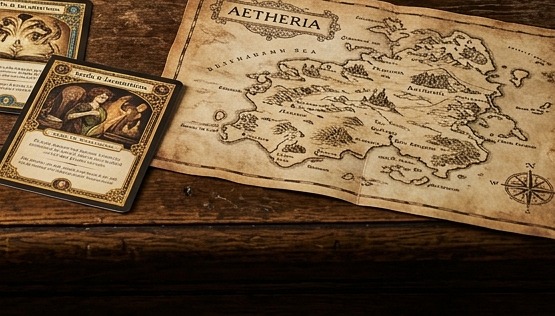
The centerpiece is MinaLima's illustrated parchment map of Hogwarts, bordered by gold foil flourishes. Surrounding the board are the castle areas, the Dark Arts Path track, and card displays.
Table Setup Steps
- Place the Board: Unfold the Hogwarts map in the center of the table.
- Assign Roles: One player sits behind the Dark Arts station; other players select a Hogwarts House (Gryffindor, Ravenclaw, Hufflepuff, Slytherin).
- Prepare the Dark Arts Path: Place the 3 Progress Markers on the initial positions of the three castle sectors.
- Seed the Library & Displays: Shuffle spell decks and place the market cards face-up in the Great Hall and Library zones.
- Initial Hand: Each student draws their starting hand of basic spells and receives their House pawn at their common room.
A House Player's Turn: The 3 Core Actions
Each student takes their turn sequentially. On your turn, you carry out three defined phases, interspersed with any eligible free actions.
Move your house pawn between connected rooms. Certain rooms contain spell books, scrolls, or encounters. Landing on Dark Arts followers triggers defensive combat or evasive maneuvers.
Spend knowledge and resources gathered during exploration to acquire new spells from the market. Crucially, in MinaLima's rules, certain acquired cards are placed directly on top of your draw deck rather than into the discard pile, allowing immediate next-turn combos.
Refill the spell market, draw back up to your maximum hand limit, and check for status effects before passing the initiative to the next student or the Dark Arts player.
Hogwarts House Playstyles & Synergies
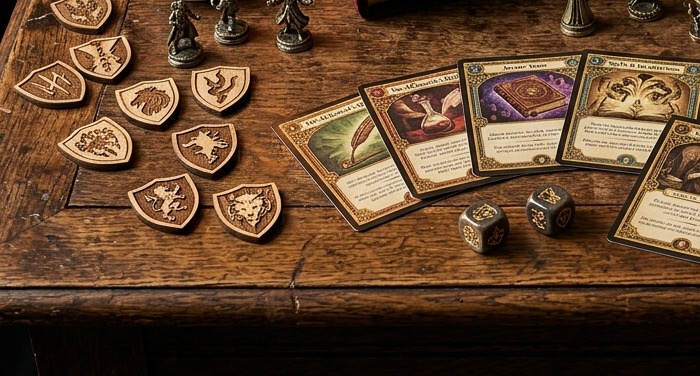
While all students begin with balanced starter decks, your house identity shapes your table presence, starting coordinates on the 7×7 map, and optimal engine-building paths.
Gryffindor
“Their daring, nerve, and chivalry set Gryffindors apart.”
Tactical Playbook & Advice
Ideal for players who prefer aggressive board positioning. Keep pawns spaced across high-traffic corridors to cut off Dark follower routes and contest the Great Hall.
The Dark Arts Path: How the Castle Falls
The Dark Arts player does not play like a normal student. Their turn revolves around corrupting castle locations, deploying Death Eaters and Dark creatures, and advancing the Dark Arts Path.
The 3 Castle Zones & The 3-2-1 Endgame
Hogwarts is divided into three key regional fronts (e.g. Castle Interior, Grounds, and Hidden Chambers). Each front possesses a designated Progress Token.
- Deploying Followers: The Dark Arts player spends malice points each round to flood rooms with followers.
- Overwhelming Zones: If followers outnumber student defenders in an area at the end of the round, the Progress Token advances 1 step.
- The 3-2-1 Climax: Once all 3 Progress Tokens reach their culmination markers, the Dark Arts player triggers the final siege. If students fail to break the concentration within 1 round, the castle falls and the Dark Arts player wins immediately.
The Loyalty Track and the Dark Detector
This is the mechanic that most casual readers and reviews miss, yet it represents the tactical heart of the student victory condition.
The Loyalty Track
As students assist one another, repel dark creatures, and complete heroic deeds, their standing on the Loyalty Track climbs. Reaching loyalty thresholds unlocks powerful senior-year charms and grants access to the Chamber of Defense, where Defence Shields are forged.
The Dark Detector
To claim the second, game-winning Defence Shield, a student cannot merely hoard books and coins. They must actively locate and calibrate a Dark Detector (such as a Sneakoscope or Foe-Glass token) to uncover hidden Dark Arts traps before the shield can be secured.
The Defence Shield Recipe
The ultimate goal of every House Student. The first student to assemble two Defence Shields instantly seals Hogwarts and claims victory over both Voldemort and rival classmates.
Library Book
11 unique ancient tomes exist in the game. Each confers powerful ongoing passive bonuses while carried.
How Each Side Wins: Victory Conditions
Winning requires completely different strategies depending on whether you play as a House Student or command the Dark Arts.
| Faction | Victory Objective | Failure / Elimination Condition |
|---|---|---|
| House Student (Solo Win) | Collect spell books, ancient scrolls, and calibrate the Dark Detector to earn 2 Defence Shields. The first student to claim two shields wins outright. | If the Dark Arts player completes the siege, or another student claims their 2nd shield first. |
| Dark Arts Player (Dominance) | Advance all 3 Progress Markers along the Dark Arts Path and concentrate followers in the Great Hall to enact total control of Hogwarts. | Any student successfully captures two Defence Shields before the final siege completes. |
Complexity, Play Time and Who It's For
Harry Potter Fans
If you love the lore, art props, and universe, this is an absolute triumph. MinaLima's visual storytelling elevates every card and board location into a collector's dream.
Complete Board Game Beginners
With 90–180 minutes of play and multiple asynchronous tracks, this is not a lightweight party game. For family game night with kids under 12, start with Hogwarts Battle instead.
Hardcore Strategy Hobbyists
Tactical depth is solid, but the early turns can feel slightly repetitive and the game balance depends heavily on the skill of the Dark Arts player. Great for theme-driven game nights.
Frequently Asked Questions on Rules
Defenders of Hogwarts supports 2 to 5 players. 1 player always controls the Dark Arts, while 1 to 4 players control student characters representing the Hogwarts houses. The community consensus on BoardGameGeek is that 4 players (1 Dark Arts + 3 students) offers the most balanced and interactive dynamic.
BoardGameGeek records the playing time as 90–180 minutes, whereas MinaLima promotional material cites ~90 minutes. In real gameplay, expect your first 1–2 teaching sessions to take between 2.5 and 3 hours. Once players understand card synergies and the Dark Arts Path, sessions comfortably finish in 90 minutes. Two-player duels run faster (60–90 min).
No. It is a semi-cooperative "one versus many" game. Students share the objective of preventing the Dark Arts player from conquering Hogwarts, but they are also racing against each other: only the first student to claim two Defence Shields wins the game individually.
No. In the base rules, all four Hogwarts houses start with identical starting cards and stats. Houses provide thematic identity, player colours, and starting locations, but your mechanical playstyle is shaped by the spells, allies, and items you acquire during the game.
MinaLima published the official rulebook PDF publicly. You can download and inspect the complete high-resolution document directly from MinaLima's media servers.