Defenders of Hogwarts Review: Is It Worth It?
An honest, playtest-grounded assessment of Studio MinaLima's tabletop deckbuilder — examining the shared-clock twist, map navigation pacing, player counts, and who should buy or skip.
The 30-Second Verdict
Harry Potter: Defenders of Hogwarts is a genuinely beautiful asymmetric deckbuilder with one of the smartest tension mechanisms in the hobby — players race each other while sharing the same clock. If you play games a few times a month and love the wizarding world, this is an easy buy. If your group plays heavy euros every week, the first hour will test your patience.
What It Actually Is
A board game by Studio MinaLima — the design house behind the graphic props of the Harry Potter films — designed by David Waterman. Not a video game, not a Hogwarts Legacy sequel, and not on any console. One player controls the Dark Forces; everyone else plays a Hogwarts house and races to be first to collect two Defence Shields.
A quick note on play time: The publisher advertises roughly 90 minutes, while BoardGameGeek's listing gives a 90–180 minute range. Our games have run between 100 and 135 minutes on average — closer to 150 minutes during initial teaching rounds, settling down to roughly 90–105 minutes once players memorize card flows and turn sequences.
What Works
✦ The art direction is not an afterthought
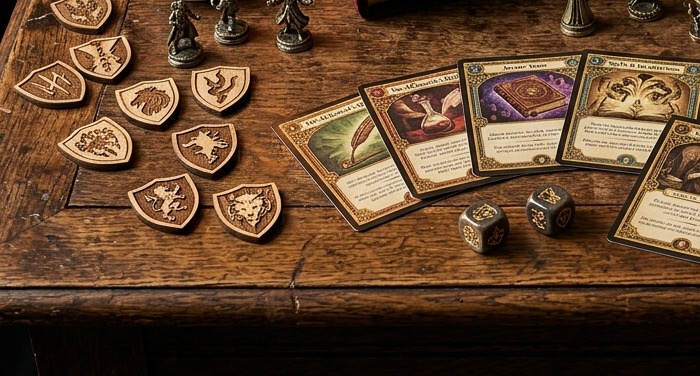
MinaLima designed the graphic props you actually see on screen in the films, and it shows in the board, the cards and the components. The authentic typography, heraldic insignias, and gold-foiled accents make the entire table feel like an interactive artifact from the wizarding world.
✦ The central twist is the real design achievement
Every time a House Player refills their hand, the Dark Arts Marker advances. So the thing you must do to keep playing is also the thing that loses you the game. It turns a co-op into a shared clock, and it makes every table talk about whether to push on or stall.
✦ Learning pays off immediately
A learned card goes on top of your draw deck, so you draw it on your very next turn. It is a small rule with a big effect: the first time you buy a good card, you feel it straight away rather than waiting for a discard pile reshuffle.
✦ The Dark Detector creates table politics
There is only one in the game, and it belongs to whoever is furthest up the Loyalty Track. It changes hands. That is a real, competitive edge inside a game where everyone is supposedly on the same side.
✦ The rulebook and iconography are clear
The 24-page full-colour rulebook illustrates turn sequences and spell flows clearly, and the included quick-reference cards mean players rarely need to halt play to look up card keywords or track increments.
What Frustrates Us
⚠️ The first act is slow
Like most deckbuilders it needs a few rounds to get going, and because you also have to traverse a map, you can burn three or four rounds before anything meaningful happens. Explaining this to a new group is the hardest part of teaching the game.
⚠️ Getting bumped back to the Great Hall stings
Losing your position and walking the same route again is the moment where the table groans. It feels punishing without adding deep tactical decisions.
⚠️ The Dark side can skip your turns
Some Dark Arts cards take the decision away from a House Player entirely. Handled well it is tense; handled badly it just feels like waiting.
⚠️ The difficulty is entirely set by the Dark Arts player
A sharp Dark player will beat a new group of students comfortably. That makes it a poor fit for players who want a fixed challenge level or a predictable co-op puzzle.
How It Plays at 2, 3 and 4–5 Players
At 2 players you get a straight duel: one house against the Dark side, with no rival students to race. Fast and intense, but you lose the inter-student rivalry and shifting loyalty tension.
At 3 players it is the most balanced version — one Dark player against two houses gives the Dark side enough room to act without being swamped, while keeping downtime between turns crisp.
At 4–5 players the table tilts towards the students, because more houses mean more shields in play and more people working the map. This is also where the racing element bites hardest, because there is real competition for the same spaces.
Is It a Board Game or an RPG?
It is a board game. You play it at a table with cards, pawns and a map — no game master, no character sheet, no campaign. Several entertainment sites described it as a new Harry Potter RPG, and you can see why: every player takes on a role. But each game is a self-contained session, and there is no digital version on PC, PlayStation, Xbox or Switch.
Who Should Buy It / Who Should Skip It
✦ Who Should Buy It
- Harry Potter fans who want the films' visual world on their table.
- Groups of 4–5 who want a game where the table talks to each other.
- Deckbuilder players looking for something lighter than the classics.
✦ Who Should Skip It
- Players who want a pure co-op. This is not one, and it does not play like one.
- Anyone who mostly plays at 2. You lose the racing element that makes it work.
- Heavy-game groups. The early game will feel slow.
- Anyone expecting a video game. See above.
Frequently Asked Questions
Partly. House Players share an enemy and a clock, but only one of them can win. One player controls the Dark Forces, while the other players race each other to be the first to collect two Defence Shields.
2 to 5 players. One seat is always the Dark Arts Player. At 2 players it is a direct head-to-head duel; at 3 players it reaches peak tactical balance; at 4–5 players the student race intensifies across the board.
Around 90 minutes by the publisher; BoardGameGeek lists 90–180 minutes. Our playtests have run between 100 to 135 minutes on average, dropping to roughly 90 minutes once players memorize card synergies.
No. All four houses start with identical decks — the difference is colour and identity, not mechanics. Your strategic deck identity develops dynamically through the cards you acquire throughout the game.
No. The game needs at least one person running the Dark Forces. There is currently no official solo mode or automated AI villain bot.